
The Role of Institutions in Technological Progress
A review of "How Progress Ends: Technology, Innovation and the Fate of Nations" by Carl Benedikt Frey

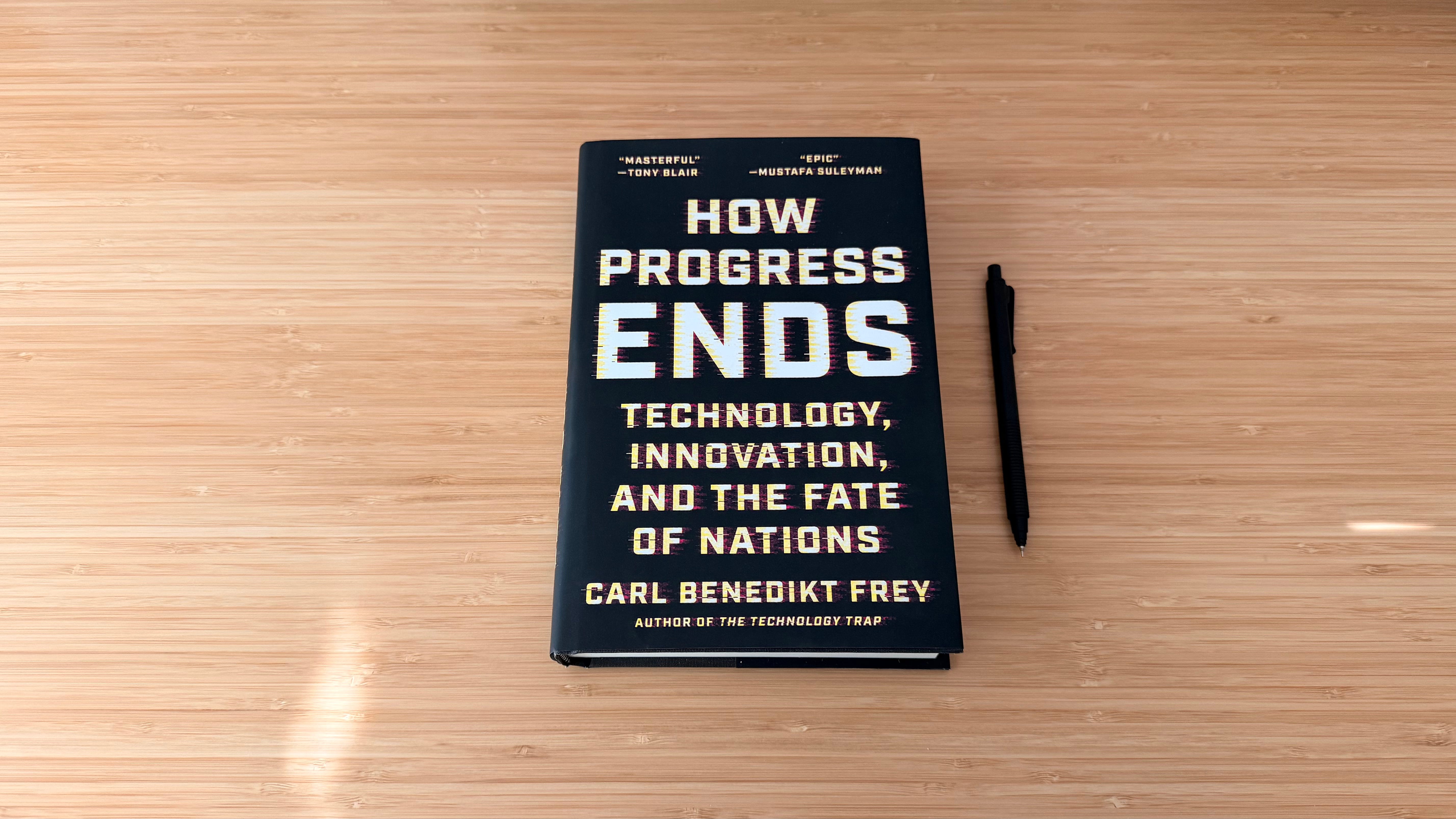
Technological progress is not an inevitable “natural” phenomenon. We have seen it accelerate, stagnate and diverge in many different forms in different moments of history. Why? In How Progress Ends: Technology, Innovation and the Fate of Nations, Carl Benedikt Frey, an economic historian and Professor of AI and Work at the Oxford Internet Institute, tries to answer this question by studying the impact that political institutions have in the development and diffusion of technology.
Frey classifies political systems into two broad categories based on how decisions about resources are made. In centralized systems, such as those we see in China and Russia today, a unified bureaucratic hierarchy determines how a nation’s main resources are distributed. In decentralized systems, by contrast, these decisions are dispersed among multiple stakeholders, chiefly the private sector. Using this framework, Frey advances the central thesis of the book: neither system is perfectly suited for every nation, nor for every stage of maturity of a particular technology. Each has its own “ecological niche”.
These systems differ in their capacity to generate distinct types of efficiency. Centralized systems are more apt for increasing static efficiency through incremental innovations. Static efficiency refers to the optimal use of labor and capital to maximize social welfare under a system’s present conditions. Because mature technologies have proven economic benefits, a single decision-making point can more easily direct resources to maximizing those benefits by developing incremental improvements. Decentralized systems, on the other hand, are better suited for achieving dynamic efficiency, that is, adapting to changes over time. Distributed decision-making fosters diversity of thought, which in turn encourages experimentation and the exploration of new technologies. Innovation is achieved over time.
Frey doesn’t treat these categories as binary. The characterization of a system as centralized or decentralized seems a matter of degree, and nations move between periods of centralization and decentralization.
The bulk of the book applies this framework to the history of China, England, Germany, France, Russia, Japan, and the United States, spanning several centuries. We learn why, for example, institutional descentralization enabled the Industrial Revolution to occur in England, where innovators to resist the guilds, and the digital revolution in the United States, where the private sector was able to leverage government investments and partnerships to drive advances in computing and digital technologies. In Europe, by contrast, centralized bureaucratic governments achieved the “Western European economic miracle” between 1950 and 1973, when productivity soared by absorbing technologies developed in the United States, but they failed to produce leading technologies or globally dominant technology firms in the 21st century.
In the last part of the book Frey reflects on the current state of affairs and warns of signs of stagnation in both China and the United States. In the last 50 years, China has effectively leveraged its bureaucracy to develop technology clusters, such as Shanghai, Hangzhou, Shenzhen, and the Rust Belt, and has allowed for privatization of certain sectors of the economy. The highly centralized, patronage-based economy under Xi Jinping has also enabled the country to excel in incremental innovations in machine learning (think of DeepSeek, or the Chinese government’s power to collect citizen data for AI). However, this same centralization may also make China to focus its resources exessively in the current data-thristy AI models, creating a technological technological lock-in that would constrain exploring alternative approaches to the development of AI.
In the United States, large firms are using AI to optimize and scale existing operations, emphasizing efficiency and expansion. But startups, which more likely to experiment with new products and business models and push innovation in new directions, are facing increasing barriers to entry. For example, Frey explains that 75% of US industries are more concentrated now than in the 1990s, and large companies entrench their position through regulatory capture. On a side note, the EU is not doing much better; the IMF calculates that the EU’s internal barriers act as a 45% tariff on manufactured goods and a 110% tariff on services, making it difficult for startups to enter the market.
A few caveats are worth noting. First, this is a dense book. At around 400 pages, although it avoids technical language, it goes deep into the history of each country You may find yourself unexpected reading about agricultural institutions in the 19th-century Tsarist Russia. Second, the analysis is tightly focused on the central thesis, so there’s not much exploration of how other factors, including instuttions like civil liberties and fundamental rights, might also play a role in the technological progress of a nation. Third, the book seems to overgeneralize the binary categorization. The book does not really explore how some countries may defy this categorization and may be better explained as hybrids that employ different approaches across sectors or technologies or even regions. Finally, I missed at least some references to the history of other regions like Latin America and Africa.
How Progress Ends is a very interesting and timely book. It offers a compelling framework for understanding current economic phenomena, from the global AI race to the new “Gilded Age” in the United States. I strongly recommend it.
Sources:
Watch a video of the author talking about this book here.